

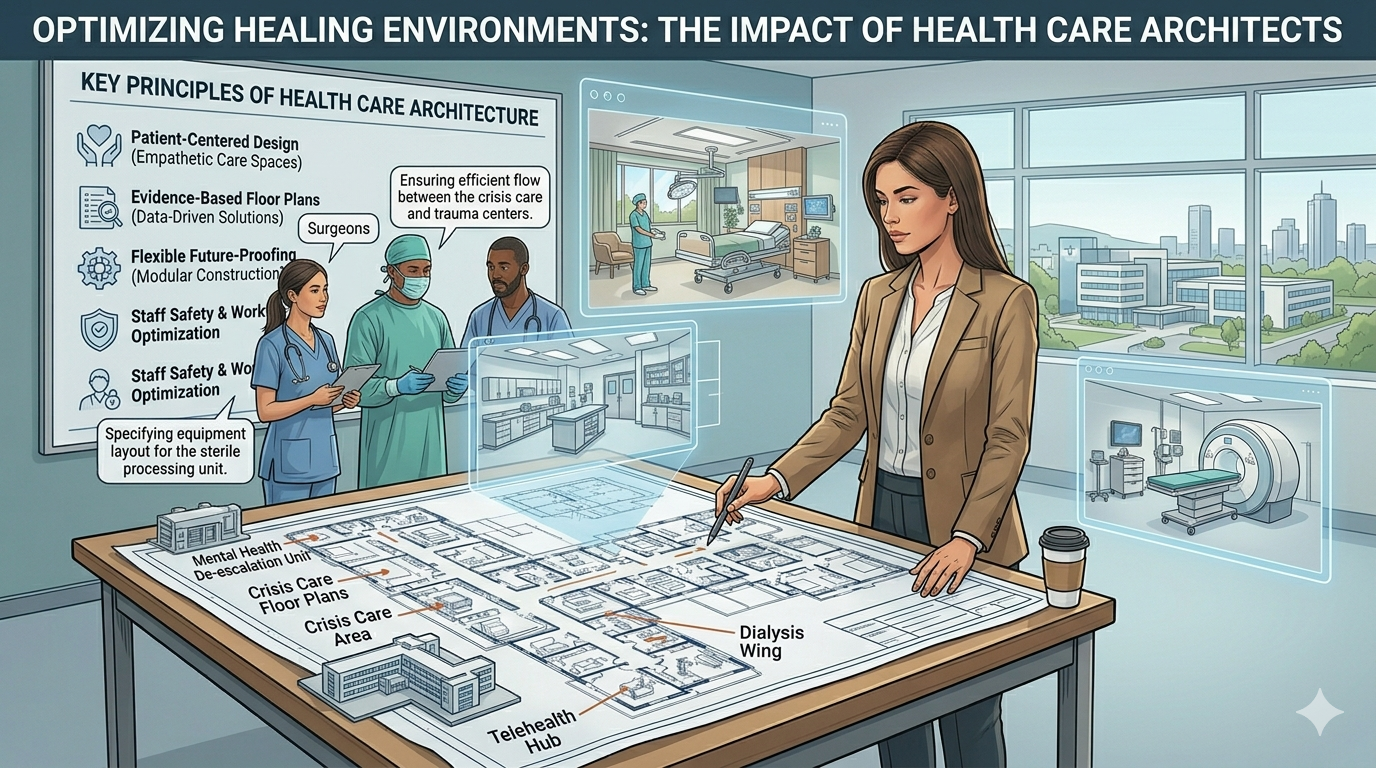
Hospital industry has evolved from a doctor centric radius to a patient-led digital ecosystem within a decade. Spaces like hospital can be highly demanding, increased scrutiny for quality healthcare have drastically pushed investors, insurance and hospital administrators to focus beyond good ambience. Hospitals require careful planning and execution. They are complex operational environments where patient recovery, staff productivity, clinical workflow, infection control, and future adaptability must work together seamlessly. Hospital specific architecture is trained in the domain; these architects differ from general architects. As highlighted by Spencer de Grey in Designing the Future Hospital: An Architect’s Perspective, a well-designed hospital can directly aid patient recovery while creating buildings that are operationally efficient, environmentally sustainable, and flexible enough to respond to evolving technologies and treatments.
Hospitals Are Operational Systems, Not Conventional Buildings
Unlike general building typologies, hospitals function as 24/7 operational systems. Every department, from OPD and emergency to ICU, OT, diagnostics, and inpatient wards must work in synchronized flow. A poorly designed hospital can lead to:
Why General Architects Often Fall Short in Hospital Projects?
A general architect may excel in aesthetics, space utilization, and conventional building design. However, hospital planning demands much more than visual design expertise.
Healthcare-specific architects understand:
The Hidden Cost of Choosing the Wrong Architect
The cost of hiring a non-specialist architect often becomes visible only after construction begins. Common consequences include:
Clinical Workflow Matters More Than Aesthetic Interiors and facades
A hospital should not be designed as a “beautiful building first” and a clinical space later. The best healthcare architects think beyond appearance.
They ask questions such as:
Patient Safety Begins with Design
Hospital architecture directly affects patient safety. Design decisions influence:
Why Early Appointment of a Healthcare Architect Is Critical
One of the most common mistakes in hospital projects is appointing the specialist architect too late. By the time feasibility, land utilization, and budgeting decisions are made, fundamental planning assumptions may already be flawed. Early involvement helps align:
Why ACME?
A hospital is one of the most complex assets an organization can build. It deserves specialists who understand healthcare, not just buildings. Because in hospital projects, good design is not about how the building looks. It is about how well it heals.
ACME Hospital Projects brings nearly three decades of dedicated healthcare consulting experience, having supported over 1,000 healthcare organisations across India and international markets since 1996. Over the years, ACME has worked across the healthcare ecosystem, including multi-speciality hospitals, tertiary care centres, medical colleges, diagnostics networks, rehabilitation facilities, day-care centres, and integrated healthcare campuses. Building on this legacy, the ACME Hospital Architects & Projects Division, established in 2019, has been focused exclusively on healthcare infrastructure planning, hospital architecture, medical planning, feasibility studies, DPR preparation, project management, commissioning support, and operational readiness for healthcare projects of varying scale and complexity.
At ACME Hospital Projects, we work closely with hospital promoters, governing boards, and healthcare investors to ensure that every project is built on clinical logic, regulatory compliance, and long-term operational efficiency. Our healthcare-specific architectural and project planning methodology ensures that every space within the hospital ecosystem is purpose-driven and operationally optimised, from emergency departments, ICUs, operating theatres, diagnostics, and inpatient units to outpatient services, rehabilitation spaces, support services, and back-end infrastructure. We place strong emphasis on balancing patient experience, clinician efficiency, biomedical requirements, statutory norms, NABH/NMC-compliant planning considerations, fire and safety standards, and long-term maintainability while developing healthcare facilities. Whether you are planning a greenfield hospital, expanding an existing facility, or redeveloping a healthcare asset, choosing the right specialist team at the outset can significantly reduce project risk and improve outcomes. Connect with ACME to build healthcare spaces that are not only aesthetically sound but operationally future-ready.

Shweta
Principal Architect & Hospital Planner

Malini
Senior Architect & Hospital Planner

Chetan
Architect & Interior Designer

Aditi
Architect & Interior Designer

Amulraj
Architectural CAD Drafter

Gunal
Architect & Hospital Planner

Ramya
Architect & Hospital Planner

Selva
Architect & Interior Designer

Manoj
Architect & Interior Designer

Pooja
Architect & Interior Designer

Aswine
Hospital Project Coordinator
Frequently Asked Questions
How do Colors impact Hospital Design?
While there is no question about the importance of Hospital Design in the Patient have a much better healing experience, the role Colours in Design has not been as understood and accepted, Read More.....
What are the steps involved in planning a hospital?
How to Start a Hospital, A hospital feasibility study is a crucial process for determining the source of patient flow for a new healthcare facility. It involves a market and financial analysis of the proposed project, Read More.....
What are the Golden Rules for Designing Hospital Interiors?
When we design the interiors of Hospitals, we are just not choosing nice paintings and pretty furniture. Along with being aesthetically pleasing, the we ensure the Hospital has a functional environment, Read More.....
What are the key considerations for designing boutique healthcare centers?
The Rise of Boutique Healthcare Centres: Light-Asset Models Transforming Urban Markets, In today's rapidly evolving healthcare landscape, light-asset, single or dual specialty centres are emerging as a preferred model in metropolitan areas, Read More.....
What are the Latest Architecture and Design Trends for Senior Care Centers?
India is currently at a critical juncture, grappling with a significant surge in its senior population and a strain on traditional family-based support models. Read More.....
How to Plan and Design Hospitals with NABH Guidelines?
Designing a hospital is more than just constructing walls. It's about creating a safe space where patients heal, families feel secure and doctors and nurses work without obstacles, Read More.....
Why are Hospitals Increasingly Investing in Renovation and Expansion?
A decade ago, hospitals were designed primarily to meet immediate healthcare needs of the community. They would have basic equipment & simple structures, designed to provide a sanctuary, with basic level, palliative care. Today’s Hospitals are highly advanced, technology driven, centres of medicine, Read More.....
Watch Healthcare Planning Seminar Videos
Any Queries, Write to Us @ contact@acmehospitalprojects.com
or Call / Whatsapp @ 9789803259 / 9840622244

Building Healthcare Facilities for the Future, that are Patient Friendly, Safe for the Patients, Visitors and Hospital Staff, Energy Efficient and Environment Friendly.

PHONE :+91-44-26426703 / 9789803259 / 9840622244


